

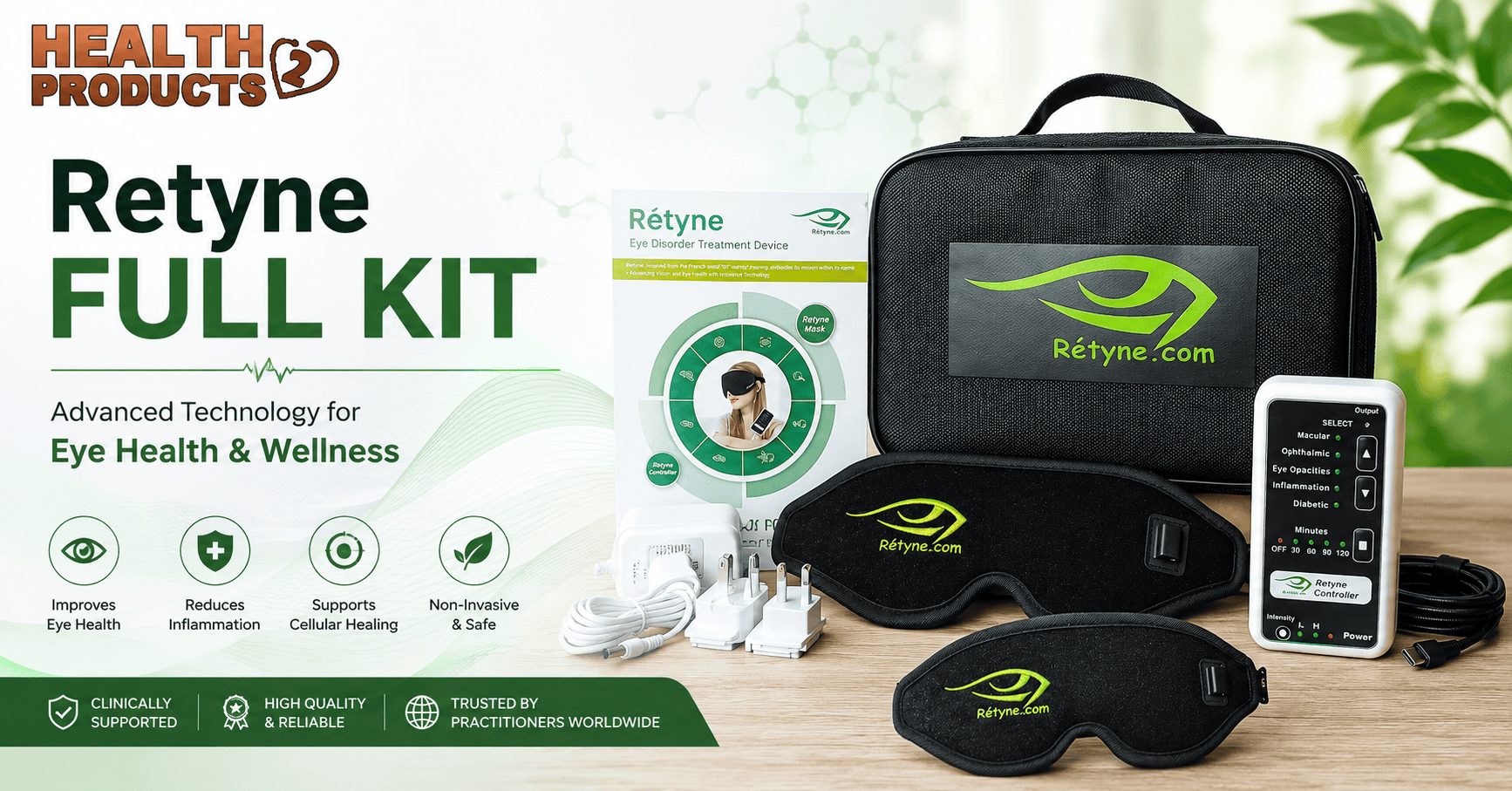
Retyne Mask and Controller: Can Light Therapy Make a Real Difference?
Comfortable vision is something everyone deserves to protect for as long as possible. The Retyne Mask and Controller is one of the tools we are most enthusiastic about in our current lineup, and that enthusiasm is grounded in real science. This blog covers what the device does, how it works, who it is designed for, and what to expect from consistent use.
What Is the Retyne Mask and Controller?
The Retyne Mask and Controller is a wearable light therapy device that delivers red and near-infrared wavelengths directly to the eye area. The mask sits comfortably over the eyes and the controller gives you full control over session duration and intensity. It is designed for home use, meaning you do not need a clinical setting or a practitioner to administer it.
The device is built around photobiomodulation, which is the use of specific light wavelengths to stimulate cellular energy production. The wavelengths used by the Retyne fall in the red to near-infrared range, which has been extensively studied for its effects on mitochondrial function in biological tissue. For the retina specifically, this matters a great deal because retinal cells are among the most metabolically demanding cells in the human body and among the first to show decline with age.
Full product details, setup guidance, and instructional videos are available directly on the Retyne product page and at retyne.com.
How Does Near-Infrared Light Support Retinal Health?
The mechanism involves an enzyme called cytochrome c oxidase, which sits within the mitochondrial respiratory chain in your cells. Photons in the red to near-infrared range are absorbed by this enzyme, which responds by increasing ATP production. ATP is the energy currency your cells run on. More ATP means more energy available for cellular repair, maintenance, and function.
For retinal cells, which burn through energy at a high rate, this boost is directly relevant. As we age, mitochondrial efficiency declines and ATP production drops. Retinal cells become less capable of maintaining normal function, which contributes to the visual changes most people start noticing after 40. Near-infrared light therapy addresses this decline at its source by giving the mitochondria the photonic input they need to produce more energy.
The Retyne Infrared Eye Mask delivers this input through a comfortable, wearable format that makes daily use practical without requiring any clinical setting or professional involvement.
What Does the Research Say About Light Therapy for Vision?
The research base for photobiomodulation in ocular health has grown significantly over the past decade. A landmark 2020 study from University College London found that participants over 40 who received weekly exposure to 670nm red light showed improvements of 17 to 20 percent in color contrast sensitivity, a key marker of retinal function (source: Glen Jeffery et al., Journals of Gerontology, 2020). The same research group has continued publishing work extending these findings across broader populations and conditions.
A 2023 review published in Ophthalmology and Therapy examined multiple studies on photobiomodulation for age-related macular degeneration and found consistent evidence of functional improvement in visual acuity and contrast sensitivity among treated patients (source: Ophthalmology and Therapy, 2023). This is not speculative science. It is a growing body of peer-reviewed evidence pointing in a consistent direction.
Who Is the Retyne Infrared Eye Mask Designed For?
The Retyne Infrared Eye Mask is designed for adults who want to take their long-term vision health seriously. This includes people experiencing age-related changes such as reduced contrast sensitivity, difficulty in low-light environments, and general visual fatigue. It also includes people managing more significant conditions including macular degeneration, diabetic retinopathy, and glaucoma, all of which involve retinal cell dysfunction that photobiomodulation is increasingly being studied to address.
One thing worth being direct about: if you consult a conventional eye specialist about light therapy, you may encounter limited familiarity with the technology. This is not because the evidence is weak. Most ophthalmologists simply have no training in photobiomodulation, and the professional associations that guide their practice have little incentive to promote tools that fall outside the pharmaceutical and surgical model. Your decision about using the Retyne is yours to make based on the available evidence. Full information is at retyne.com.
How Do You Build an Effective Session Routine?
This is where a lot of new users underestimate what it takes to see meaningful results. Brief, occasional sessions are a starting point, not a complete protocol. If you are using the Retyne to address age-related visual decline or a specific retinal condition, you need consistent sessions at meaningful durations.
The Retyne controller supports session durations of 30, 60, 90, and 120 minutes. Shorter sessions of 10 to 20 minutes are useful as part of a daily maintenance practice. The longer and more consistent your sessions, the more the therapy accumulates and the more meaningful the results become over time. Think of it as a long-term investment in your visual health rather than a quick intervention.
Here is what a practical routine looks like for most users:
- Daily sessions of 30 to 60 minutes as the core practice
- Shorter sessions of 10 to 20 minutes on lighter days or for maintenance
- Consistent use over weeks and months to allow cumulative benefit to build
- Use the controller to adjust intensity based on your comfort and response
- Track any changes in visual quality over time, including contrast sensitivity and low-light performance
Instructional videos covering setup, session protocols, and how to get the most from the device are available on the Retyne product page and at retyne.com.
Our team at Health Products 2 is available at 206-708-6408 or through our contact page if you have questions about whether the Retyne is the right fit for your situation. Visit our home page to explore our full range of bio-electric and light therapy products.
Protecting Your Vision with the Retyne Mask and Controller at Health Products 2
The Retyne Mask and Controller represents exactly the kind of technology Health Products 2 is built to support: grounded in real research, practical for home use, and addressing something that matters deeply to the people who need it. Vision health is not something to leave to chance. Visit our home page and take the step toward protecting your most important sense today.
Frequently Asked Questions
A: Meaningful results require consistent sessions of 30 to 120 minutes over weeks and months. Shorter sessions of 10 to 20 minutes are useful for daily maintenance but work best alongside longer sessions.
A: The Retyne is a wellness device, not a medical treatment. However, photobiomodulation research increasingly shows positive effects on retinal function in people with macular degeneration. Consult our team for guidance.
A: Yes. The device is designed for regular home use. Follow the session guidelines provided with the device and available at retyne.com.
A: Instructional videos are available on the Retyne product page and at retyne.com. Scroll down the product page to find the video tutorials.
A: The Retyne uses red and near-infrared wavelengths in the range most effective for stimulating cytochrome c oxidase in the mitochondrial respiratory chain, which increases ATP production in retinal cells.